Why Correct Addressing Matters
Every year, millions of pieces of mail are delayed or returned due to addressing errors. In Canada, proper address formatting isn't just a nicety—it's essential for ensuring your mail reaches its destination.
Canada Post uses automated sorting machines that read addresses. When addresses don't follow the standard format, mail may require manual processing, causing delays, or worse, be returned to sender as undeliverable.
This guide will teach you exactly how to format addresses for Canadian mail, common mistakes to avoid, and how modern solutions can eliminate addressing errors entirely.
The Standard Canadian Address Format
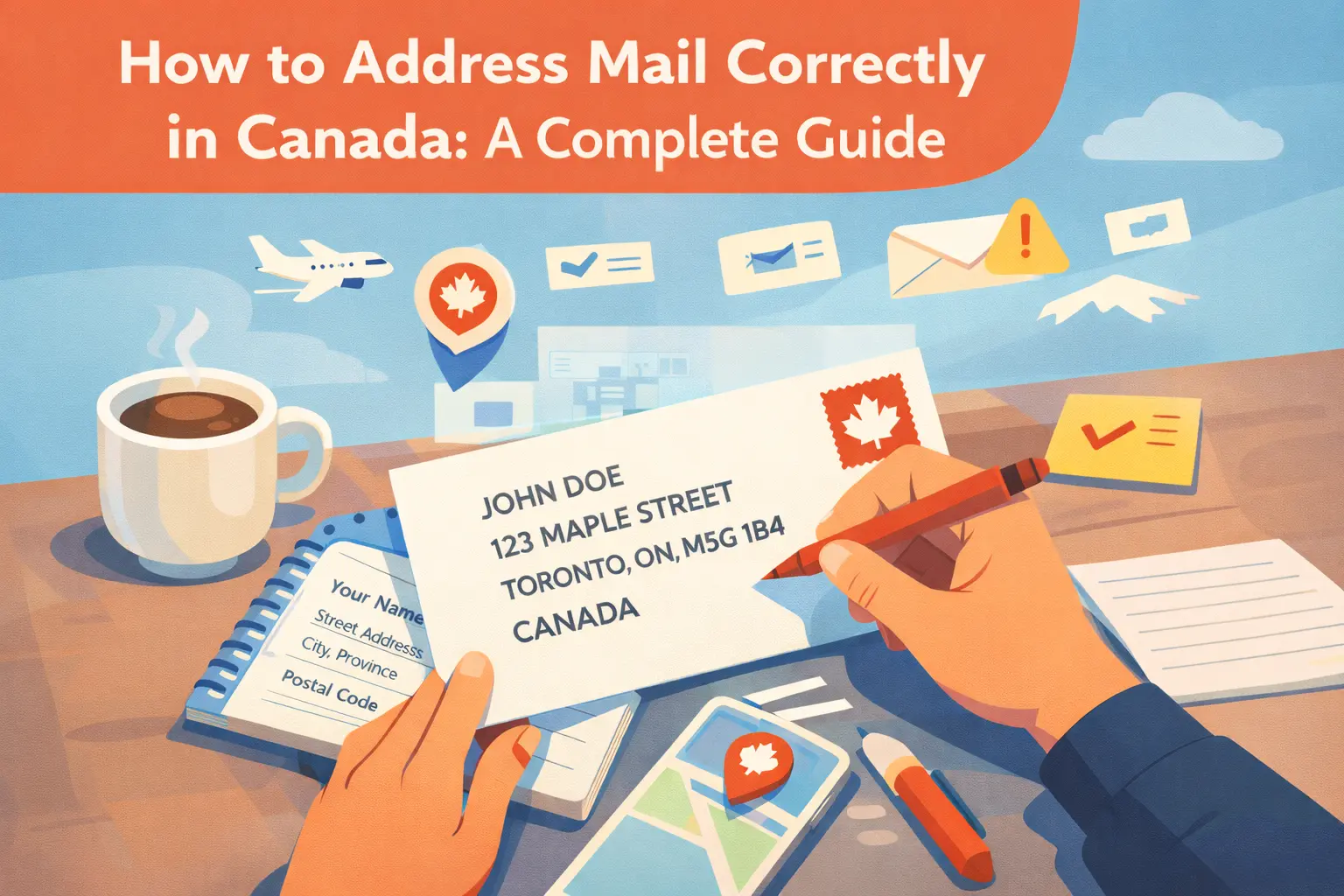
A properly formatted Canadian address includes these elements in a specific order:
Recipient's Address (Center-Right of Envelope)
JANE SMITH
APT 302 - 456 MAPLE STREET
TORONTO ON M5V 2T6
Breaking It Down:
- Line 1: Recipient's name (person or business)
- Line 2: Unit/apt number, street number, and street name
- Line 3: City, province abbreviation, and postal code
Return Address (Top-Left Corner)
Your return address follows the same format and should be placed in the upper-left corner of the envelope.
Canadian Province and Territory Abbreviations
Always use the standard two-letter abbreviations for provinces and territories:
- AB - Alberta
- BC - British Columbia
- MB - Manitoba
- NB - New Brunswick
- NL - Newfoundland and Labrador
- NS - Nova Scotia
- NT - Northwest Territories
- NU - Nunavut
- ON - Ontario
- PE - Prince Edward Island
- QC - Quebec
- SK - Saskatchewan
- YT - Yukon
Important: Don't spell out the full province name. Automated sorting systems expect the two-letter abbreviation.
Understanding Canadian Postal Codes
Canadian postal codes follow a specific format: A1A 1A1 (letter-number-letter space number-letter-number).
Key Rules for Postal Codes:
- Always include a single space between the two halves
- Use capital letters
- The letters D, F, I, O, Q, and U are never used
- The first letter indicates the province or region
First Letter by Region:
- A - Newfoundland and Labrador
- B - Nova Scotia
- C - Prince Edward Island
- E - New Brunswick
- G, H, J - Quebec
- K, L, M, N, P - Ontario
- R - Manitoba
- S - Saskatchewan
- T - Alberta
- V - British Columbia
- X - Northwest Territories, Nunavut
- Y - Yukon
Common Addressing Mistakes to Avoid
These are the most frequent errors that cause mail delivery problems:
1. Missing or Wrong Postal Code
The postal code is the most critical element for sorting. A missing or incorrect postal code can send your mail to the wrong city entirely.
2. Missing Unit or Apartment Number
For multi-unit buildings, the unit number is essential. Without it, mail carriers can't deliver to the correct door.
Correct: APT 5 - 123 MAIN ST
Incorrect: 123 MAIN ST (missing unit)
3. Illegible Handwriting
Automated sorting machines and mail carriers need to read addresses clearly. Messy handwriting causes delays and misdeliveries.
4. Wrong Address Format
Putting elements on the wrong lines or in the wrong order confuses sorting systems.
5. Using Old or Incorrect Postal Codes
Postal codes can change. Always verify the current postal code for your recipient's address.
6. Abbreviation Errors
Using incorrect abbreviations (like "Ont." instead of "ON") can cause processing issues.
Addressing International Mail from Canada
When sending mail internationally, you need to include the destination country and may need to adjust the format:
To the United States:
JOHN DOE
123 BROADWAY AVE APT 4B
NEW YORK NY 10001
USA
To the United Kingdom:
MS SARAH JONES
45 HIGH STREET
LONDON
SW1A 1AA
UNITED KINGDOM
Key Tips for International Mail:
- Always write the country name on the last line
- Write the country name in capital letters
- Use English or French for the country name (Canada Post's official languages)
- Follow the destination country's address format for the internal address
PO Boxes and Rural Addresses
Not all addresses follow the standard street format. Here's how to handle special cases:
PO Box Addresses:
ROBERT BROWN
PO BOX 1234
REGINA SK S4P 3B2
Rural Route Addresses:
MARY JOHNSON
RR 2 SITE 5 BOX 10
LACOMBE AB T4L 2N2
General Delivery:
For recipients without a fixed address in a community:
JAMES WILSON
GENERAL DELIVERY
BANFF AB T1L 1A1
The Foolproof Solution: Let Technology Handle It
Even with this guide, addressing errors are easy to make. One typo in a postal code or a forgotten apartment number can mean your mail never arrives.
This is where online mailing services shine. Services like PostPal use structured forms with built-in validation to make addressing errors virtually impossible.
How PostPal Prevents Addressing Errors:
- Structured Forms: Separate fields for each address component ensure nothing is forgotten
- Postal Code Validation: The system verifies postal codes are in the correct format
- Required Fields: You can't submit without filling in essential information like unit numbers
- Automatic Formatting: Addresses are printed in the correct Canada Post format every time
- No Handwriting Issues: Printed addresses are always perfectly legible
Why This Matters
When you use an online form to enter addresses, you're guided through each required field. The system won't let you forget the postal code or skip the apartment number. And because addresses are printed by machine, there's no risk of illegible handwriting.
It's addressing made foolproof.
Conclusion
Properly addressing mail is essential for ensuring your letters and packages reach their destinations. By following Canada Post's standard format and avoiding common mistakes, you can minimize delays and delivery failures.
Quick Reference Checklist:
- Use the standard format: Name, Street Address, City Province Postal Code
- Include unit/apartment numbers for multi-unit buildings
- Use two-letter province abbreviations
- Double-check postal codes
- Write clearly or use printed labels
- Include the country name for international mail
Or, skip the hassle entirely. Use PostPal and let our validated forms ensure your mail is addressed correctly every time. No more worrying about formatting, postal codes, or legibility—just fill in the fields and we handle the rest.